
Affiliate marketing is a business model in which you recommend products or services and earn a commission when someone completes a qualifying purchase or sign-up through your unique referral link. It can be inexpensive to start, but successful affiliate marketing requires useful content, a clear audience, trustworthy recommendations, and consistent measurement.
This guide explains how to start affiliate marketing from scratch, choose a profitable direction, build a content system, find legitimate programs, and improve results without relying on misleading tactics.
What Is Affiliate Marketing?
In affiliate marketing, there are usually three key parties:
- The merchant: The company selling a product or service.
- The affiliate: The publisher, creator, or media brand recommending that offer.
- The customer: The person who clicks a referral link and takes the required action.
After approval to an affiliate program, the affiliate receives a trackable link. If a customer uses that link and meets the program’s conditions, the merchant records the referral and pays a commission.
Commission structures vary. Some programs pay a percentage of a sale, while others pay a fixed amount for a qualified lead, a new account, or a new paying customer. This is why a small number of highly relevant clicks can sometimes be more valuable than a large volume of low-intent traffic.
Why Affiliate Marketing Appeals to Beginners
Affiliate marketing can be a practical first online business because it does not require inventory, product development, fulfillment, warranties, or direct customer support. The merchant handles the product and customer relationship after the referral.
It also has relatively low startup requirements. A basic website, content tools, and a way to create and distribute useful material may be enough to begin. However, low startup cost does not mean effortless income. Building trust, publishing consistently, and learning what converts can take months.
The model works best when approached as a media business, not as a collection of random links. Your real asset is the audience, content library, brand credibility, email list, and website you build around a specific subject.
Set Realistic Affiliate Marketing Goals
Affiliate marketing revenue is not guaranteed, and results differ widely by niche, audience quality, content format, offer payout, and consistency. A better early goal than chasing a large income claim is to validate the system.
For example, a beginner might aim to publish consistently for six months, generate measurable referral clicks, identify one or two useful offers, and work toward a modest monthly revenue target. That creates a foundation for improvement based on real data instead of assumptions.
Think in terms of compounding assets:
- One useful comparison article can continue attracting search traffic.
- One long-form tutorial can remain relevant for years if it solves an enduring problem.
- One short-form post can introduce new people to a guide or resource.
- One email subscriber can receive future updates, comparisons, and recommendations.
Choose an Affiliate Marketing Niche You Can Sustain
A niche is the focused topic your content covers. Choosing one helps people understand what your brand is about and makes it easier to create relevant content, build topical authority, and find suitable affiliate marketing programs.
Use the three-part niche test
Before committing, evaluate a possible niche against these three questions:
- Do you know it or genuinely enjoy learning about it? You need enough interest to keep producing useful content.
- Are there products or services worth recommending? Look for legitimate offers that directly solve your audience’s problems.
- Does the topic create recurring questions? Good niches have comparisons, reviews, beginner guides, troubleshooting topics, and buying decisions.
Finance, software, supplements, home products, and mattresses are examples of categories with affiliate opportunities. But a high commission alone is not a good reason to enter a niche. A topic you do not care about can become difficult to cover consistently, and shallow recommendations damage trust.
Do not choose based on payout alone
Some physical products have small percentage commissions. A low-priced product may generate only a small amount per sale. Meanwhile, certain financial products, software products, or business services may pay higher fixed fees or revenue shares.
Still, payout is only one variable. The better decision is usually the offer that matches the reader’s needs, converts well, has reasonable terms, and can be recommended honestly. A relevant product with a strong audience fit is more valuable than an unrelated offer with a large advertised commission.
Build a Content Engine, Not Just a Link Page
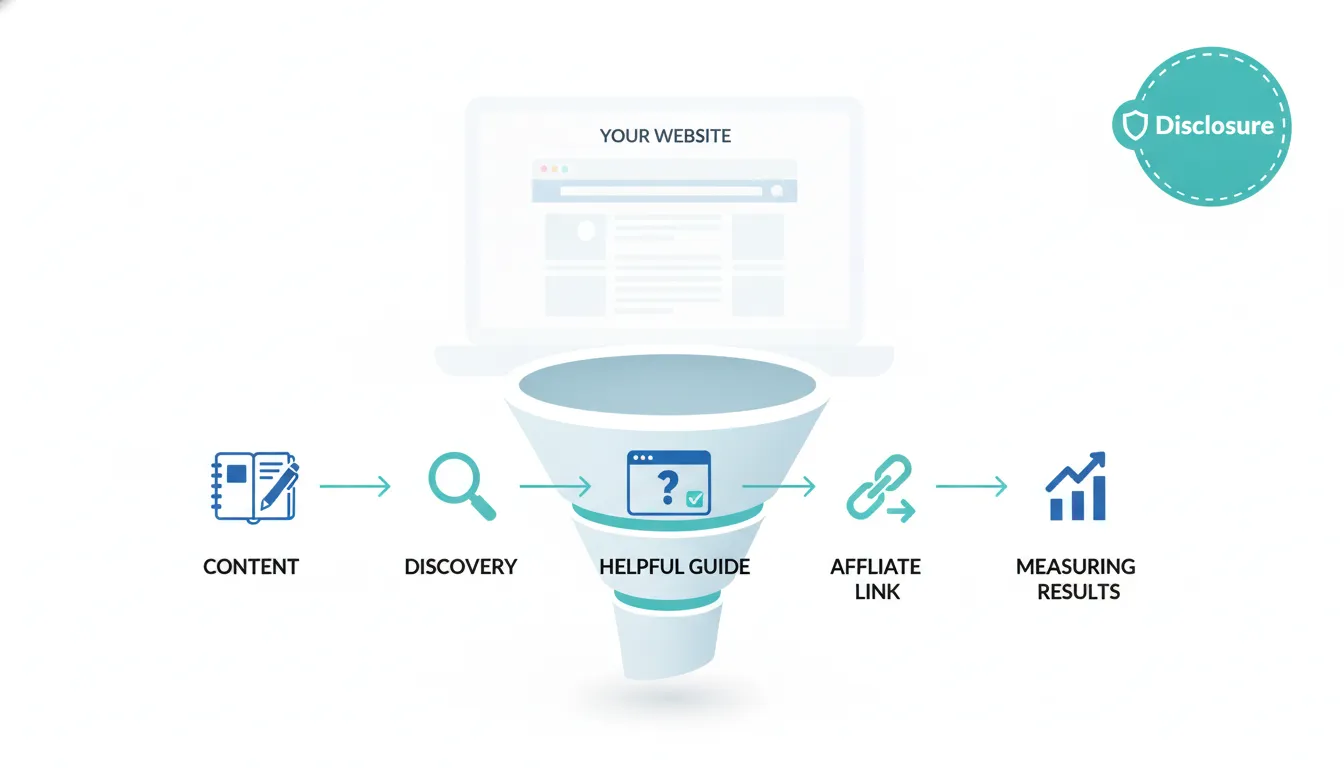
The central challenge in affiliate marketing is attracting the right people and helping them make an informed decision. A content engine is a repeatable path from discovery to helpful content to a relevant recommendation.
A simple model looks like this:
- Create content that answers a specific question.
- Reach people through search, long-form content, short-form content, or social platforms.
- Offer a useful next step, such as a detailed guide, comparison, checklist, or product review.
- Send visitors to your website, where they can evaluate the options in more depth.
- Place relevant affiliate links naturally within the resource.
- Measure clicks and conversions, then improve the content and offers.
Start with short-form content for discovery
Short-form content can be repurposed across platforms, making it a useful way to test topics and attract initial attention. Focus each post on one narrow problem, such as a beginner mistake, a product comparison factor, or a quick explanation.
Use a specific call to action that leads to a useful resource. For example, a post about student credit card options could invite people to request a detailed comparison guide. Rather than sending people directly to an affiliate link, the guide can give them context, explain tradeoffs, and direct them to a complete article on your website.
DM automation tools can help deliver requested guides when someone comments a chosen keyword. ManyChat is one option for building this type of automated message flow. The resource should provide genuine value, not simply disguise a sales link.
Add long-form and evergreen content
Long-form tutorials, detailed reviews, and search-focused articles can continue producing value after publication. A thorough beginner guide, comparison, or solution-oriented article can attract people who are actively researching a purchase or sign-up.
Useful affiliate marketing content ideas include:
- Best tools for a specific type of user
- Product A versus Product B comparisons
- Beginner tutorials that explain how to use a product category
- Buying guides that explain which features matter
- Honest reviews based on direct experience
- Calculators, checklists, and downloadable guides that simplify a decision
Prioritize the reader’s problem first. A page should still be useful even if the reader never clicks an affiliate link.
Why Your Website Matters in Affiliate Marketing
A website gives your affiliate marketing business a home you control. Social platforms can help with discovery, but your website can hold detailed reviews, comparison tables, free guides, email sign-up forms, disclosures, and searchable evergreen resources.
A simple site should include:
- A clear brand name and a memorable domain
- A homepage explaining who the site helps
- Topic pages or categories for your niche
- Detailed articles and comparison guides
- An affiliate disclosure page
- Contact and policy pages appropriate for your business
Choose a short, clean domain that feels credible and is easy to remember. A .com is familiar to many people, though other concise extensions may work when the name is unavailable.

Website builders can reduce the technical barrier to publishing. If you need a simple place to host reviews, guides, and affiliate marketing articles, Hostinger website hosting and site builder is presented as an option for creating a site without coding.
| Build a home for your affiliate content Create a website for guides, reviews, comparison pages, and email capture. Explore Hostinger |
How to Create Affiliate Content That Converts
Affiliate links work best when they appear at the point where a reader is ready for a relevant next step. They should support the content, not interrupt it.
Use clear, contextual links
In a comparison guide, place the affiliate link beside the explanation of why the product may suit a particular person. Make links visibly clickable and use direct labels such as “Check eligibility,” “See current pricing,” or “Visit the provider.”
You may also link relevant buttons, product names, or images where permitted by the affiliate program. Avoid misleading buttons, fake download links, or vague wording that hides the destination.
Create decision-focused pages
Strong affiliate marketing pages help readers decide. A useful structure might include:
- Who the product is for
- Key benefits and limitations
- Important pricing or qualification considerations
- How it compares with alternatives
- A direct recommendation for specific use cases
- Relevant referral links and a clear disclosure
For example, a high-yield savings account guide should explain the comparison criteria and account differences before suggesting where to apply. Do not let a commission determine the ranking. Readers can recognize when recommendations are not credible.
Find Affiliate Programs and Products to Promote
Many established companies offer affiliate programs directly or through affiliate networks. Start by listing products you already use, understand, and would be comfortable recommending.
Search for direct programs
A straightforward research method is to search for the company name followed by “affiliate program.” Read the official program page carefully before applying. If no public program exists, it may be reasonable to contact the company and ask whether it offers a partnership arrangement.
Use affiliate networks
Affiliate networks bring multiple merchants into one platform and usually provide reporting, link creation, application tools, and payment tracking. The source material highlights Impact.com as a network with many brands across categories and PartnerStack as a platform commonly associated with software and technology offers.
When evaluating an offer, look beyond the headline commission:
- Commission type: Percentage, flat fee, or recurring revenue share
- Qualifying event: Sale, approved lead, free trial, account opening, or paying customer
- Cookie window: The time period in which a click may still be credited to you
- Program restrictions: Rules on paid ads, brand terms, claims, email, and social promotion
- Audience fit: Whether the offer truly helps the people you serve
Understand cookie windows and EPC
A cookie window, sometimes called a referral window, is the length of time after a person clicks your link during which you may receive credit for a conversion. Windows vary by program. A shorter window generally gives the customer less time to purchase while still being attributed to your referral.
Earnings per click, or EPC, is another useful metric. It estimates how much revenue is generated per referral click. EPC can help compare offers, but it should be used alongside conversion rates, payout terms, content relevance, and the quality of the customer experience.
Measure the Numbers That Actually Improve Revenue
Affiliate marketing is easier to improve when you track each stage of the journey. Traffic alone is not the goal. The goal is qualified traffic that finds a useful recommendation and takes action.
Track these core metrics:
- Content reach: How many people see a post, article, or tutorial
- Click-through rate: The percentage of visitors who click a referral link
- Conversion rate: The percentage of clicks that produce the intended action
- EPC: Earnings generated per click
- Revenue by content piece: Which guides, reviews, or topics produce earnings
- Revenue by merchant: Which offers are worth continued attention
If one article receives many visitors but produces few clicks, the recommendation may be poorly positioned, insufficiently relevant, or unclear. If people click but do not convert, investigate the offer, the audience fit, the merchant page, and whether the content set accurate expectations.
Use these findings to create more of what works. If a specific question, format, platform, or offer consistently performs well, expand that area rather than spreading effort equally across everything.
Build an Email List Alongside Your Content
Email gives you a direct way to share new guides, useful updates, and relevant recommendations with people who chose to hear from you. It can also reduce dependence on a single search engine or social platform.
Offer something worthwhile in exchange for an email address, such as a checklist, comparison worksheet, beginner guide, or curated tool list. Then send helpful updates instead of frequent promotional blasts.
Email messages can contain affiliate links when program rules allow it, but always check each merchant’s terms. Keep the same standard used on your site: accurate information, clear disclosures, and recommendations that serve the subscriber’s interests.
Affiliate Marketing Compliance and Trust
Trust is the long-term advantage in affiliate marketing. Promote products you have used or researched thoroughly, explain downsides honestly, and never make claims you cannot support.
Disclose your affiliate relationship
Affiliate disclosures should be clear and easy to notice near the recommendation or link. In the United States, the Federal Trade Commission’s disclosure guidance explains why material connections should be disclosed clearly and conspicuously.
A simple disclosure can state that you may earn a commission if someone purchases through your links, at no additional cost to them. Do not hide disclosures in a footer, a long terms page, or an unclear abbreviation.
Read every program’s terms
Each affiliate program has its own rules. Some restrict paid advertising, trademark bidding, direct linking, email use, coupon messaging, or the claims affiliates may make. Breaking those terms can lead to removal from the program and loss of a revenue source.
Before publishing, confirm:
- The link is approved and correctly formatted
- The promotion method is allowed
- Your claims match the merchant’s current information
- Your disclosure is present and understandable
- Your content does not imply guarantees or misrepresent the product
Common Affiliate Marketing Mistakes to Avoid
Promoting products you would not recommend
A large commission is not worth losing credibility. If the product is poor, irrelevant, or unsuitable for your audience, skip it. Sustainable affiliate marketing depends on repeated trust, not a one-time conversion.
Publishing generic content with no audience need
Do not write only broad “best products” lists. Start with real questions and specific situations. Content aimed at a defined need is more likely to be useful and convert.
Sending every click directly to an offer
Direct links can work in some situations, but detailed content usually gives readers more confidence and gives you a stronger owned asset. A guide or review page lets you explain the recommendation and present alternatives.
Ignoring performance data
Without tracking, you cannot tell whether a problem is traffic, clicks, conversions, or the offer itself. Review performance regularly and use the results to prioritize your next content decisions.
Using deceptive or prohibited tactics
Do not use fake urgency, hidden redirects, misleading claims, or tactics that violate merchant rules. Short-term gains from questionable methods can cost you a program relationship and your reputation.
A Simple 6-Month Affiliate Marketing Action Plan
- Month 1: Choose one niche, define the audience, research products, and set up a basic website.
- Month 2: Apply to relevant affiliate programs and publish foundational guides that answer core questions.
- Month 3: Begin consistent short-form distribution and direct people toward useful on-site resources.
- Month 4: Publish deeper comparisons, reviews, and beginner tutorials. Start collecting emails with a useful lead magnet.
- Month 5: Review click-through rates, conversions, EPC, and top-performing topics. Improve weak pages.
- Month 6: Double down on effective content formats and offers while removing recommendations that do not serve the audience.
The key is consistency. Publish helpful material, observe what people respond to, and improve the system over time.
Frequently Asked Questions About Affiliate Marketing
Is affiliate marketing legitimate?
Yes. Affiliate marketing is a legitimate performance-based marketing model used by many companies. It becomes problematic when affiliates use deceptive claims, fail to disclose commissions, or violate program rules.
Do you need a website for affiliate marketing?
A website is not always required to join every program, but it is highly valuable. It gives you a reliable place for detailed guides, reviews, affiliate disclosures, email capture, and search-focused content.
How much does it cost to start affiliate marketing?
Costs can be low compared with businesses that require inventory or equipment. Common expenses may include website hosting, a domain, software, and content production tools. The exact amount depends on the platform and tools you choose.
How long does affiliate marketing take to make money?
There is no fixed timeline. Results depend on the niche, content quality, traffic sources, audience trust, and offer fit. Treat it as a long-term business and give yourself enough time to publish, measure, and improve.
What is a cookie window in affiliate marketing?
A cookie window is the period after someone clicks your affiliate link during which a later conversion may still be credited to you. The length varies by merchant and program.
Can you do affiliate marketing without a large audience?
Yes. A smaller audience with a specific need can be more valuable than broad, uninterested traffic. Focus on helpful content for people actively researching a relevant decision.
Final Takeaway
Affiliate marketing works when you build useful content around a focused niche, recommend products responsibly, and improve decisions with data. Start with one audience, one clear topic area, and a small number of high-quality resources. Build the website and content library first, then let trust and consistent optimization drive the business forward.
0 Comments